 COLLINGWOOD INGRAM
ornithologist
and plantsman
COLLINGWOOD INGRAM
ornithologist
and plantsman
New - November 2025
The story of the saving of Taihaku has been questioned by Professor Wybe Kuitert, an authority on Japanese cherries. The article is Cherry fame: Collingwood Ingram and Taihaku by Wybe Kuitert in Die Gartenkunst 2025 (2) 309-323)
and a link to the article is here
It may take a little while to download
The Taihaku story
For those, perhaps not many, unfamiliar with the Taihaku story. …..
…… Collingwood Ingram, in the journal of his 1926 visit to Japan, described a conversation, through an interpreter, with the veteran cherry expert Seisaku Funatsu. During the conversation Mr Funatsu showed Collingwood a painting by his great grandfather. Collingwood wrote at the time in his journal that the painting ……..
…… depicted very accurately, if somewhat crudely, the large-flowered single cherry I found at the Freeman’s which I have named Tai-Haku. Apparently its correct name is Akatsuki – meaning “daybreak” or “dawn” …….. Mr Funatsu said he had long been searching in vain for this Akatsuki variety! It is a curious thing that it should be found again in a remote Sussex garden
Collingwood came away from the conversation believing that Taihaku had the original name of Ataksuki and that it was lost to Japan. Back in England he was quick to publish the story of the saving of Taihaku in the Gardeners’ Chronicle, a story which has been retold innumerable times down the years and has become part of garden folklore.
Professor Kuitert’s research
The following is my summary of the research. I recommend that the full paper is read. I make some comments in italic.
(1) Taihaku was not Akatsuki
Professor Kuitert shows that Akatsuki, which had very large, double, slightly pink flowers, was a quite different cherry from Taihaku. It seems that both Taihaku and Akatsuki were in Mr Funatsu’s painting and it was Akatsuki, not Taihaku, that he said was lost to Japan. This was a crucial misunderstanding.
Comment. I find this convincing – the suggested cause of the
mistake, confusion between two cherries in the painting, is speculative, but there seems little doubt that the mistake was made.
Taihaku must have had another name in Japan – what was it?
(2) Taihaku is Komatsunagi
Professor Kuitert writes that, centuries ago, some individual wild mountain cherry trees were given the name Komatsunagi. The name translates as a tree to “tie a horse to”; indicating a substantial tree. Early descriptions and paintings suggest that a cherry. presumably selected from amongst these mountain Komatsunagi, was cloned and cultivated as a village cherry, retaining the name Komatsunagi. Professor Kuitert’s research suggests that it was identical with Taihaku. Over the years some different cherries have appeared under the name Komatsunagi, but the cherry identical with, Taihaku is the one with a long historic provenance. DNA studies in 2014 show that the Komatsunagi present in Japan today is genetically identical with Taihaku.
Comment. Interpretation of historic information, especially illustrations, and untangling the complex history of Japanese cherries is not easy. However, Professot Kuitert presents an impressive body of historical evidence, as well as more recent information, to support his hypothesis.
The two main aspects of Professor Kuitert’s research, the Akatsuki misunderstanding and the identical Taihaku/Komatsunagi hypothesis, together provide a logical narrative.
However, different scenarios may be possible, and no doubt other cherry researchers will contribute their knowledge and thoughts in due course.
The Taihaku story helped to make Cherry Ingram famous in the gardening world and beyond. but even without this story his contribution to our knowledge of Japanese cherries and to their worldwide popularity is immense. If he made a mistake, it was a glorious mistake!
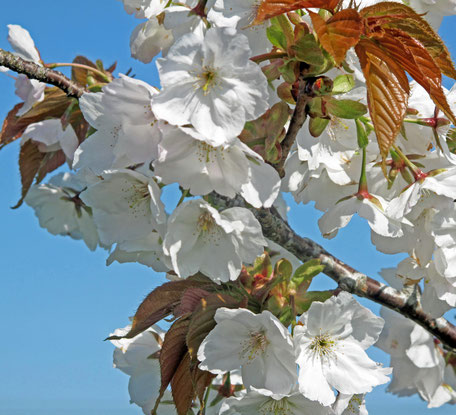
The blossoming of Taihaku, or Komatsunagi, around the world is a direct result of Collingwood’s enthusiasm, energy, and love of Japanese cherries


