 COLLINGWOOD INGRAM
ornithologist
and plantsman
COLLINGWOOD INGRAM
ornithologist
and plantsman
Birds of France, war threatens
Collingwood set off once more for France on Sunday 10 May 1914 only three months before the outbreak of WW1. Disembarking at Le Havre, he drove first east to cross the Seine at Quillebeuf and then south-west towards his destination, the mountains of the Auvergne
Sunday 10 May 1914, Caen
So fair was the passage that the stopping of the engines as we entered Havre harbour was the first thing to recall us to consciousness. As there was no need to hurry away, it was nearly nine before we were on the road for Quillebeuf, the nearest point at which we could cross the Seine. It is vexing to have to turn one’s back on one’s destination and this is what I had to do when going from Havre to Caen. The road, however, when once clear of the pavé and tramlines of the town, is good enough. It passes along the eastern side of the river valley under beetling cliffs of weather-stained chalk. Innumerable jackdaws make these flinty and creviced cliffs their summer home, and under some overhanging ledges formed by the weathering of the softer strata it is just possible that some house martins build. A flock of these birds, at any rate, were manoeuvring in front of these apparently suitable nesting sites. Carrion crows were common all the way to Caen and near Quillebeuf were working the river as methodically as an Egyptian kite, digging right down on to the water to glean the passing scraps. At intervals of ten to twenty miles I noticed parties and flocks of rooks; they appear to be tolerably numerous through this part of Normandy. Wrens, yellowhammers, stonechats, blackbirds and, of course, magpies were all common wayside birds, while whitethroats and common redstarts were hardly less numerous. Starlings were few and far between, but I saw three or four during the day’s run.
12 May 1914, Blois (Loir et Cher)
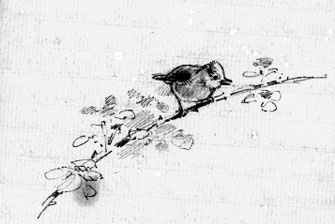
What a difference a clear sky makes. The grey pall of the last two days has disappeared and the country looks as green as ever with countless golden flowers drinking in the sunshine – and yesterday they were all huddled up and shrinking in a chilly wind. Birds were also more en evidence, and among some spreading hedgerows a few miles out of Alençon I made my bow to the melodious warbler. With recollections of my encounter with his larger cousin, the icterine, in Picardy last year still fairly fresh in my memory, I will now draw a comparison between the two species. In life, the melodious warbler is noticeably the smaller bird and, here at any rate, his song is not nearly so loud and boisterous in character. I purposely confine my remarks to this locality, for both the melodious warblers I heard today – and I listened with rapt attention for a long time – seemed to select quieter songs for their model and did not mimic the noisy rattle of a blackbirds or such-like cries that entered so frequently into the loud medley of the Picardy bird; but perhaps autre pays, autre moeurs and in other districts they may have a louder voice and borrow from different songsters.
My approach seemed to aggravate the bird and just as a boy will throw stones at an enemy from a safe distance, so this warbler hurled his defiant notes at my head from the shelter of a thorny thicket. By slowly moving my position I managed to get a good view of him between the leaves. Perched on a spray of bramble, I saw him leaning forward, his crest distinctly raised and his delicate primrose throat inflated, while he eye seemed almost as bright as a mouse. Chizee, chizee, chizee – the swallow’s alarm note – opens the music, but this is quickly followed by a flow of more complex melody, half borrowed from a whitethroat and half from a skylark. Occasionally the running song is broken by a series of plaintive phylloscopine tu-eets or the chatter of a sparrow, but these hardly detract from the very effective whole. By the way, the melodious warbler resembles the icterine in the use of this scolding, sparrow-like chatter as an alarm note.
On some southern slopes at St-Calais I first saw vines and, shortly after, noted a crested lark and then others followed on. I presume therefore that something in the soil or the climate suits both plant and bird, for M. Brasil tell me the latter is very rare in Calvados. The crested lark seemingly prefers a light, dry soil, or at least, should this be wanting, a sunny climate.
This is about the point I observed rooks for the last time – indeed the two or three I saw in the distance near the town were the only individuals recorded and I am not certain of these!
14 May 1914, Châteauroux (Indre)
After lunch, we crossed a stony, calcareous plain, reminding me not a little of the cultivated, corn-growing portions of Salisbury Plain. This proved to be the home of quite a number of “new” species. Little bustards were common and one frequently heard their ventriloquistic ptrr – a sound cheating the ear of at least half the distance. I am still in doubt as to the whistling noise accompanying the “forced” spring flight. Is it mechanical and produced by the wings, or is it uttered by the bird? When flying in this way, the wings are kept much depressed, like a duck about to alight, and at the same time the head and neck are carried stretched out in an almost erect position.
Stone curlews were plentiful on the poorer ground. I not only saw and heard a number wailing in the distance, but saw half a score without troubling to look for them.
Wheatears were now quite numerous. They were mostly in pairs and with one exception were obviously all small-sized birds. The exception was a female, which I judged from her tameness and size, to be a passing Greenlander.[Northern form of wheatear] The others were much shier and I tried in vain to secure a specimen for my collection. Some of their notes did not seem altogether familiar and indeed I see no reason why this apparently southern race should not be as distinct from the English bird as that, in turn, is from the giant northern form S. leuchorrhoea [?].
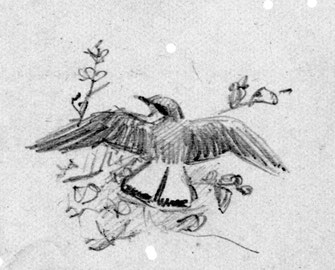
Wheatears were now quite numerous. They were mostly in pairs and with one exception were obviously all small-sized birds. The exception was a female, which I judged from her tameness and size, to be a passing Greenlander.[Northern form of wheatear] The others were much shier and I tried in vain to secure a specimen for my collection. Some of their notes did not seem altogether familiar and indeed I see no reason why this apparently southern race should not be as distinct from the English bird as that, in turn, is from the giant northern form S. leuchorrhoea [
In the course of its jerking, upward love flight I noticed a male half settle on a small roadside elm, its tail fanned out and in such a way as to look twice its normal size and dazzlingly white. One of the functions of the white rump and tail was partly explained by this action, for they were evidently being used to greatest advantage during this kind of nuptial display.
Among some rough ground, where limestone had been quarried, I found a wheatear’s nest placed at the end of a short burrow. It contained five much-incubated eggs of a rich blue colour, one sparingly marked with reddish-brown specks. This measured 21.75 by 16mm. A couple of ortolans were identified, both very confiding.
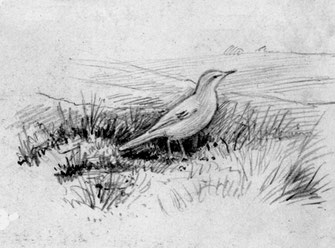
Another addition to my list was the tawny pipit. Its cry at first made me look for a wagtail, but although resembling the chiz-zee of these birds I was soon able to detect the difference, chiefly on account of its more ringing timbre with the accent rather on the second syllable. This cry the bird repeats frequently and especially during an upward, sweeping flight, the sound being emitted at each series of wing beats. On the ground it looks a very sandy coloured bird, the eye stripe and wing pattern being the most conspicuous features in the drab plumage. It strikes one as a well-made, graceful bird.
The quail’s whit-whit-whit was frequently heard from the corn fields of this great rolling plain – while the chubby, short-tailed crested lark was always busy on the gritty roads and corn buntings seemed very common.
Three common sandpipers were playing and feeding on a shingly island in the mid-stream of the Dordogne – a river eminently suited to its habits so that it probably nests here.
A considerable number of house martins are nesting on the old houses and Chapelle of Rocamandour.
18 May 1914, Rocamadour (Lot)
This is the strangest of towns – a huddle of dark-roofed houses flatten themselves against the wall of a great beetling cliff in a vain endeavour to seek shelter under the overhanging rock.
Upon the very brink of this cliff and brooding over, as it were, the frightened houses below, stands an ancient château – or should I sat the site of an ancient château for it appears to have been renovated out of all recognition. But man is not the only rock-loving creature that makes this cliff its home; jackdaws, common and alpine swifts and a pair of kestrels all appear to be nesting on the precipice above the town. The alpine swifts interested me the most because I hardly expected to find them here. As evening approached they became noisy and uttered a shrill, chattering cry as they swept into and under the face of the rock, and I heard their shrill crying, only in more subdued tones, even after they had retired for the night in some of the larger vertical crevices. I emphasise “vertical” as the birds appear to have selected these intentionally – possibly on account of their larger size, while the smaller species were using the more natural horizontal crevices lower down. The cry of the alpine swift in no way resembles the squeaking screech of the smaller bird, being not only louder, but a shrill, almost frenzied, chattering sound. They are fine flyers these white-bellied birds and on the wing their movements easier, that is hardly so hurried, as those of the lesser species. From the limestone cliffs opposite Rocamadour I heard the unmistakable croaking of a raven.
Soon after leaving Brive I noticed two spotted flycatchers and heard others in the hotel garden earlier in the morning. I think blackcaps are now replacing garden warblers and probably predominate from here southwards. Serins observed in some numbers, but seem to still affect the tall trees of private grounds or town jardins.
The scrubby oak woods that cover many of these rather flattened hills – the truffle country of Perigord – are not rich in bird life. This is hardly to be wondered at, for the blue, sun-bleached limestone outcrops everywhere and is only thinly covered here and there with a poor, iron-stained, red soil. In the valleys Bonelli’s warbler, marsh, long-tailed and great tits, golden oriole, cuckoo, jays and magpies, and among the cliffs large numbers of jackdaws – probably a numerous but fairly isolated colony, for I have seen none since Châteauroux.
Cirl buntings, woodlarks, green woodpeckers, carrion crows (only two or three – none seen yesterday, seemingly becoming scarce in the lower lands), wrens, mistle thrushes and blackbirds also observed.
21 & 22 May 1914, le Lioran
This great mass of volcanic rock rising out of the very heart of France and culminating in the Plomb du Cantal (1858m) is exceedingly interesting as it forms, zoologically and botanically speaking, a kind of alpine island lying between the Alps proper and the Pyrenees. Here we find, at corresponding elevations, a great many of the same species. The majority of these are what I call “northern” birds, which find in the altitude the required humidity and coolness of climate that they delight in more boreal latitudes. The vertical changes in bird and plant life are often very sharply defined and in not a few instances the two are no doubt correlative – goldeneyes and spruces is a case in point.
In reviewing my notes I have arrived at the following conclusions as to the respective zonal distributions in the Cantal mountains, but from my brief knowledge of the district and total ignorance of two of the watersheds these are necessarily mostly approximate and are only based on my own personal observations.
[here a diagrammatic representation of vertical zones occupied by bird species]
One of the most interesting inhabitants of the spruce forests was the long clawed tree creeper. It seems a quiet bird and during the last three days I have not heard it sing once, but it occasionally uttered the shrill, quivering little call note shared also by the brachydactila[1] group. It is either very sparing with this cry or the birds are scarce in the forest for, being anxious to obtain a specimen, my ears were constantly on the alert for this sound and I had some trouble in securing two birds. Both these are decidedly pale in coloration as they all appeared to be. I suppose matching the hoary lichen-covered tree trunks upon which they live.
Goldcrests were plentifully scattered among their favourite trees and their amazingly thin zizzling song was constantly piercing the silence – but apart from this sound, and its occasional flourishes, which I take to be a kind of call note, I discovered today that the male has a much more pretentious song into which he introduces quite a number of respectably loud tit-like noises.
21 & 22 May 1914, le Lioran
This great mass of volcanic rock rising out of the very heart of France and culminating in the Plomb du Cantal (1858m) is exceedingly interesting as it forms, zoologically and botanically speaking, a kind of alpine island lying between the Alps proper and the Pyrenees. Here we find, at corresponding elevations, a great many of the same species. The majority of these are what I call “northern” birds, which find in the altitude the required humidity and coolness of climate that they delight in more boreal latitudes. The vertical changes in bird and plant life are often very sharply defined and in not a few instances the two are no doubt correlative – goldeneyes and spruces is a case in point.
In reviewing my notes I have arrived at the following conclusions as to the respective zonal distributions in the Cantal mountains, but from my brief knowledge of the district and total ignorance of two of the watersheds these are necessarily mostly approximate and are only based on my own personal observations.
One of the most interesting inhabitants of the spruce forests was the long clawed tree creeper. It seems a quiet bird and during the last three days I have not heard it sing once, but it occasionally uttered the shrill, quivering little call note shared also by the brachydactila[1] group. It is either very sparing with this cry or the birds are scarce in the forest for, being anxious to obtain a specimen, my ears were constantly on the alert for this sound and I had some trouble in securing two birds. Both these are decidedly pale in coloration as they all appeared to be. I suppose matching the hoary lichen-covered tree trunks upon which they live.
Goldcrests were plentifully scattered among their favourite trees and their amazingly thin zizzling song was constantly piercing the silence – but apart from this sound, and its occasional flourishes, which I take to be a kind of call note, I discovered today that the male has a much more pretentious song into which he introduces quite a number of respectably loud tit-like noises.
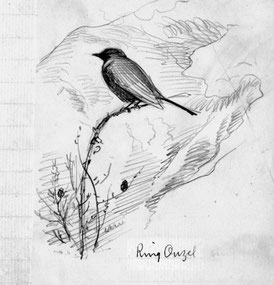
Ring Ouzel
At the edge of the forest, just as in the Jura mountains last year, I met with the little hedge sparrow, and here too I was pleasantly surprised to meet with the ring ouzel. I would like to have obtained one of them to ascertain the species, but even through my glasses I could see the white spangling on the breast of a male as he sat full in the sunshine singing from a tree-top, so they are probably the true alpestris. [1] The fact that these birds are always to be found among the spruce at the fringe of the forest makes it probable that they nest in the branches of the trees here just as they are supposed to do in the Jura, where they are equally a sylvan species. The loud and somewhat harping orphean warbler-like note, repeated three or four times in succession and recurring constantly, seems to be characterise its song and distinguishes it from those of other European thrushes. Its alarm cry is a chack-chack-chack.
Song thrushes make the mornings and evenings beautiful with their clear, true-rung notes and mistle thrushes were also denizens of this forest. Likewise blackbirds, a nest of which, containing four young about six days old, was discovered. Only a comparatively small number of coal tits have been seen.
Where the weather-stunted trees thinned out and finally gave way to the alpine pastures, I heard and saw a tree pipit, but from here onwards this open country was rightly the province of the alpine pipit and his song filled the sparking air with music.[2] Rising with an ecstasy of emotion he soars up in the deep blue sky, singing, singing, singing all the while, then down he sails on half-closed wings, steeply slanting body and uplifted tail: with a graceful spiral and a change of tone in his cadence song, he alights again on his own particular rock or snowdrift. Against the dazzling white of the latter one can easily note the strange courtship attitude he sometimes assumes after such a performance. The tail is still uplifted, the wings drooping and he moves steadily on flexed lags with strutting action, almost like a turkey cock.
Skylarks were met with near the very top – say about 5000ft and here I noticed two buzzards soaring around the peaks. A rock thrush drew my attention by his fluty, “blackbirdy” song, and as he sailed away his white rump showed conspicuously in the sunlight. Swifts were heard and seen when near the summit, sailing far overhead. They must have been at least 6000ft up, which illustrates the gr
eat height to which these birds repair during the heat of midday.
A black redstart (seen also close to the hotel) was noted near the mountain shelter at about 4800ft, near which point I found a wheatear in a short burrow running about 18 inches under a stone into the side of the slope. It contained five perfectly fresh eggs. The nest was composed almost entirely of bents and rootlets, with two or three feathers and some felt from a raptor’s casting. One or two other wheatears were noted.
Wheatear burrow
Two linnets seen near the forest; [3] spotted flycatcher, grey wagtail, garden warbler, goldfinch and dipper all recorded from near Lioran (3300 ft). Carrion crow only seen lower down.
31 May 1914, Boulogne-sur-Mer
I devoted this morning to the valley of the Somme, a little above Abbeville. Shaded with avenues of towering poplars, this level stretch of marshy meadowland, interspersed with willow-lined dykes and bosky pools, is a veritable paradise for the marsh warbler while it is no less rich in other forms of tree-loving species. No sooner had I crossed the river and turned into a field than I heard the voice of that incomparable songster – and every time I hear the marsh warbler it is with renewed and surprised delight. Its song is certainly the best of the acrocephaline warblers, I might say the best of all the warblers and perhaps it would hardly be an exaggeration to aver the best of all the passerine birds, and in so doing I have not forgotten the poets’ darling nightingale with its marvellous, if somewhat florid music. True the marsh warbler’s song is a composition of other birds’ notes, but only the finest passages are picked out of their songs and these artfully modified and woven into a very harmonious whole. The influence of the skylark and nightingale was very audible in the singing of my first marsh warbler today – while once or twice I heard the faint echo of the yaffle’s cry. [4] And yet these widely different sounds were so skilfully handled that that they seemed to fall naturally into the tune.
Although the little musician was very faithful to one particular spot in a rank, weed-grown ditch, a very careful search failed to reveal his nest, but all the while my presence provoked such pleasing music I was more than compensated for the disappointment.
The day was sultry and a haze hung over the valley, conditions hardly conducive to bird-song. Notwithstanding, I saw and heard a goodly number of species. An ortolan’s mellifluous notes rolled softly out upon silence, a smooth, oily sound full of the opulence of summer, and then the muffled hoo, hoo, hoo of a hoopoe.[5]
Tree sparrows were nesting in their favourite pollarded willows; a short-clawed creeper[6] was heard among the bigger poplars; garden warblers common, song thrush singing, tree pipits and skylarks likewise.
In the walled grounds of a château, whose tree-grown garden gave on to the river, I was shown two nests of the icterine warbler – the one containing five eggs had been accidentally disturbed by the gardener’s boy and the eggs were all broken. They were on the point of hatching: the other nest was only just completed. Both were placed in similar situations; viz. among the loose, rather frail and thin branches of a tree-shaded undergrowth – the first in an alder about five feet from the ground and the second in a snowberry bush barely three feet six inches high. As one might expect from nests built in such unstable positions, the cavity is made proportionally deep and swelling rather larger towards the base. The following are the measurements of the first nest – diameter of internal rim 2 inches, depth 1.8 inches.
[detailed description of the nest]
I paid a visit to the famous Baie de Somme and there made friends with a local chasseur, a bootmaker of Noyelle. It seems from a wildfowler’s point of view, the Baie has been spoilt by the recently constructed railway embankment running across the mouth of the river, which has caused draining of the land inside and a considerable silting up of sand without. Notwithstanding its lost glories, wealthy men from Paris still come down and use elaborately constructed huttes. In some of these, so my informant told me, telephone communication has been installed, enabling one hidden sportsman (sic) to ‘phone to the other so that he may not fire should an especially large flock happen to be coming in his (the speaker’s) direction. “Ca, c’est practique”, said the shoemaker, “bien practique”. It may be practical enough, but it does not tally with my notion of sport, and the wonder is that the poor little cardonnier, with his too old gun and too young dog, and his primitive decoy, could speak with tolerance of such practices, manifestly inimical to his own and truer sport. It seems to me these French gunmen are as patient as the French canal-bank fishermen, and both keep their sporting ardour alive by anticipation and retrospective success of a past generation rather than by experience.
This man tells me he had shot an avocet about a month before (note the Marmatton collection contains four from this district, also killed in April (12th and 13th) and two others (Sept. 18th and Aug. 19th).
A few lapwing and some ringed plover were doubtless nesting; a party of redshank were also seen, but otherwise shore birds were conspicuous by their absence. Skylarks there were in plenty, for they love these alluvial flats, and a fair sprinkling of meadow pipits. Some white wagtails and a “yellow” wagtail of sorts were also noted – the latter was probably rayi for I was able to identify a fine male of this species later in the day, while those I saw last year were also identifiable to this species.[7] This is apparently the breeding species in the NE corner of France. Crested larks are still plentiful and many have the appearance of being unusually pale, no doubt due to their having dusted themselves on the white, gritty sands.
Later the road passed near the sand dunes. A strange rabbit country this, so bereft of vegetation that the white, wind-formed hills of sand have the barren aspect of a Sahara. Here and there the silver-leaved sea buckthorn flourishes, but only as a low scrub. On the outskirts, pine woods help to keep the encroaching sand at bay and under the shelter of these a few deciduous trees and shrubs manage to exist. No wonder bird life proved scarce – a few wheatears and stonechats were living at the edge of the dunes, while near cover I saw yellowhammer, turtle dove, woodpigeons, carrion crow, nightingale, blackbirds, wrens, willow wren, chiffchaff, tree sparrows and cuckoos. Corn buntings are common in cultivated districts. A hen harrier (I am almost sure it was a hen harrier) passed over some corn-land near Le Crotoy. Starlings were rather more plentiful in the country traversed today.
Collingwood Ingram returned to England just two months before the outbreak of the Great War. At the start of the war his book, The Birds of France, had reached a late stage, a little in proof, some in typescript. Some still in manuscript. He did not complete it. The war itself may have been responsible in some way, but whatever the reason only a small part of his researches, described in these journals was, published, as The Birds of the Riviera, in 1926.
[1] Ingram is writing of the alpine race of the ring ouzel, Turdus torquatus alpestris. He wrote at the foot of the page ‘Some I saw today (22nd) appeared to have black breasts.’
[2] The ‘alpine pipit’ of Ingram’s time is now called the water pipit (Anthus spinoletta).
[3] Ingram added at the foot of the page “Although this seems to be the first entry of linnets I must have seen others before.”
[4] Yaffle, a name still used for the green woodpecker.
[5] Ingram added at the foot of the page “although this appears to be the first entry, other hoopoes have been seen, but not many”.
[6] Ingram uses both ‘short-clawed’ and ‘short-toed’ for this tree-creeper .
[7] Today the yellow wagtail is regarded as a subspecies of Motacilla flava.


