 COLLINGWOOD INGRAM
ornithologist
and plantsman
COLLINGWOOD INGRAM
ornithologist
and plantsman

Old windmill near Candas
Thursday 8 March, Candas
Just beyond the station, an old mill stands by the roadside looking delightfully quaint with its fat round body of brick and stone, its wooden (I believe wooden ‘tiles’ of this description are called shingles), hat-like roof from which depends a sort of pigtail; and its four arms, supporting the tattered remnants of brown sails.

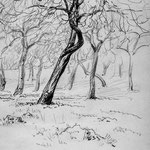

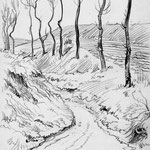

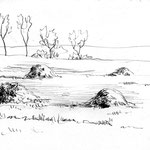


In his sketchess and words, Collingwood gives us rare glimpses of the coutryside of north-east France behind the lines and unaffexted by the destruction of war.
Wednesday 27 June, Lealvillers
After reporting to HQ at Hesdin I came on here last night. It was an entrancing day, sparkling sunlight, a soft summer breeze and a marvellously clear atmosphere. For miles we sped over great rolling plains that stretched away in blue-shadowed folds to far horizons where they met a fairyland of clouds.
Dropping down into the valley of the Authie we followed the course of this river for a considerable distance. At one point I was tempted to stop the car and explore a very attractive looking marshy woodland. The luxuriance of the vegetation was something to remember and with its towering poplars, tangled undergrowth and trailing creepers – for there was a riot of wild hops – its resemblance to a tropical forest was more than a suggestion.
The play of sunlight in the foliage of a poplar that is being gently moved by a light breeze is always a thing of great beauty, and this effect was to be seen at its best among the huge trees that spread their branches over the acres of alder scrub. The whole scene seemed punctuated with little dots of light and shade – of light green and dark green, yellow green and blue green and whenever the breeze stirred among the upper branches these dots danced and scintillated like the sparkle of rippling water.
With the watery dykes, rank undergrowth and shady trees I had great hopes of meeting the marsh warbler in this swampy wood. I heard the few opening bars of a song that may have been uttered by this bird, but could not swear to it – had it been earlier in the season of course it would have been an easy matter to have named the bird population, but now the great majority are silent and in the dense thickets it is impossible to distinguish them.


