 COLLINGWOOD INGRAM
ornithologist
and plantsman
COLLINGWOOD INGRAM
ornithologist
and plantsman
Trinidad and Tobago
From mid-December 1912 to mid-January 1913 (in the middle of the hunting season), Collingwood travelled with his father William to the West Indies to visit Little Tobago, where three years earlier his father had introduced birds of paradise. From there he went on to visit the strange guacharos, or oil birds, deep in a cave in Trinidad.
7 December 1912, Lisbon, SS Arcadian
Left Southampton about noon of the third. On the following morning, when well into the Bay of Biscay, a number of kittiwake had appeared and there were some in attendance upon the ship pretty well all the way to Lisbon. Nearing land a few lesser black-backed gulls joined them and, in the mouth of the Tagus, hundreds of black-headed gulls arrived and entirely substituted the kittiwakes but did not oust the larger species, some of which (adult and immature) were constantly present during our visit to this port…….
3 January 2013, Little Tobago
Situated roughly 11o 30/ N latitude and 60o 32/ W longitude, Little Tobago lies about a mile and a half off the NE end of the main island, some rocks known collectively as Goat Island dividing the channel about mid-way. A strong current, almost constantly running in a northerly direction, is liable to meet the incoming swell and create a choppy sea, under which conditions it is by no means easy to reach the sandy cove which usually affords a convenient landing place.
Little Tobago, about a mile in length, is obviously formed by three small, but tolerably steep, hills, the highest of which now stands at about 490ft above sea level. According to the official estimates, the acreage is only 240, but if one takes into consideration the inequalities of the ground, there is no doubt that this is greatly understated.
The island is densely clothed with vegetation, the salt-sprayed rock, especially on the windward side, being overgrown with a mass of fleshy-leaved upright cactus amongst which there are, here and there, Turk’s head. The rest of the island is fairly evenly wooded, groves of fan palm, Thrinax radiata, predominating, while a striking characteristic of the undergrowth is the immense quantity of big-leaves – an aroid plant bearing foliage of gigantic lanceolate leaves. [1] It is also an epiphyte and many of the trees are burdened with ponderous clumps of this great plant. I noticed that it even clung to the slender trunks of the Thrinax, the roots embracing the upright supports.
In the more sheltered and possibly more fertile valleys, the vegetation assumes a more imposing character and the trees, in their struggle to reach the light, attain the great heights so often found in a true tropical forest. Water is rather scarce and can only be relied upon normally at one point – a small spring of water, apparently full of organic matter and unfit for human use, percolates through the soil of one of the small ravines. As it does not appear to be extensively utilised by the birds, one can only assume that the heavy dews are sufficient to satisfy their wants.
This is a brief description of the island my father purchased with the idea of introducing the greater bird of paradise (Paradisaea apoda) into the West Indies.
……... My father had also had clearings cut for the cultivation of papaws and bananas. It was at once obvious that the food supply afforded by these open spaces had attracted nearly all the bird life on the island…….
…….. spending several hot and very fatiguing days in vainly
perambulating the island we were finally rewarded at this spot by getting a fair view of two more birds, while my father, who had remained near the papaw patch most of the afternoon, had the good fortune to see no less than five or six. Three of these he saw dancing, that is to say the immature birds best attempt at the more elaborate display of the fully attired adult.
[1] Collingwood added at the foot of the page, ‘Breaking one of these leaves off at random I found it measured fully seven feet in length.’
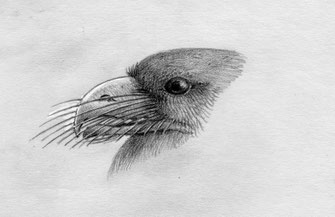
Collingwood and his father left Little Tobago on the 4th of January and on the 12th Collingwood set off for a 24 hour visit to the large Guacharo cave in the Oropouche mountains in Trinidad. The Guacharo or Oil Bird, Steatornis caripensis, is an inhabitant of caves and uniquely adapted to life in the dark. On Collingwood entering the cave, the birds were disturbed and flew distractedly around.
12th January 1913, Oropouche Mountains
…… After a while the birds settled down a little and in the dim gloom I could make them out sitting on their nests – often two side by side – and could dimly see their largish black eyes looking out of scared, harrier-like, faces. The browns of the plumage harmonized so admirably with their environment that it was not easy to trace their outline, but one could see enough to tell that they were squatting horizontally like a goatsucker [1] and possessed a large expanse of tail I attempted to take a flashlight photo of a group of nests, but unfortunately the surroundings were too dark and the result proved a sad failure. The lurid blue-white light was sufficient to engrave the image on my mind – it showed for a brief moment a roomy vault with huge, blunt-shaped, stalactites pendant over a sheet of glistening water on which, knee-deep, the three of us stood, torch in hand. Every ledge was piled with the dark, peaty deposit, moulded into many much-truncated cones on which huddled the nesting birds. Overhead a few still fluttered nervously in the shadows. Of course the sudden flash of light set all the birds awing again, and when we dropped back into comparative darkness again the cavern was filled with their deafening screams.
[1] Goatsucker, a nightjar.


