 COLLINGWOOD INGRAM
ornithologist
and plantsman
COLLINGWOOD INGRAM
ornithologist
and plantsman
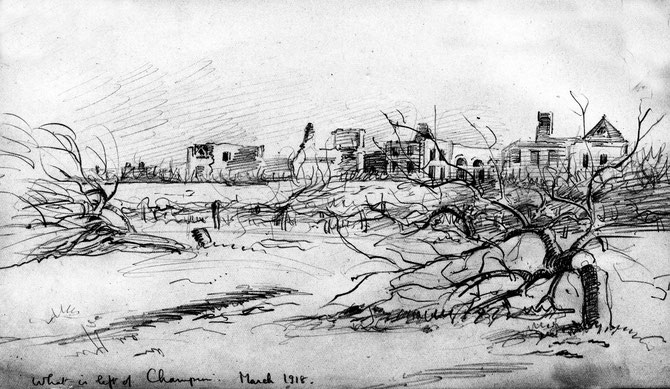
Collingwood wrote in his diary "It is a commonplace platitude to say that modern warfare is devoid of romance. Romance indeed? It seems to me that war is merely legitimisation of murder .
A reviewer in Cross and Cockade International wrote
".... a fascinating and nuanced picture of life
on the Western Front and, ultimately, records
the triumph of nature over warfare"
Key events in Collindwood's war. as recorded in his diaries, published in full as Wimgs over the Western Front
The secret German retreat to the Hindenburg line
Sunday 25 February 1917, Savy
The evacuation of a large tract of country by the enemy on the Miraumont Front resulted in a rather strange question being put by Major Powell (OC 13 Squadron). He asked several pilots, as they came in from patrol, whether they had seen anything of the Huns – ‘Headquarters VII Corps have rung up to say they have lost the Bosches and ask if we have seen anything of them??!’. Later I heard it said that we did not know the enemy had abandoned certain trenches until we noticed that they were shelling their own line – evidently under the impression that we had ‘taken over’.
The war zone
Tuesday 27 March 1917, Candas
…… It was during the course of this excursion that I first came into actual contact with the horrors of this War – the uncared for dead, lying upon fields, mutilated and disfigured beyond recognition by many months of shell fire. The year-old rat-eaten corpses, the shrivelled dismembered limbs, still booted or clothed, the half-bare skulls – these are not subjects to dwell upon – but they tell their tale of heroism – for surely only heroes or madmen would have attempted to cross that open stretch of pitted ground between those ugly barriers of barbed wire.
Bloody April
Friday 13 April 1917, Candas
Had a flight in an FE2d this morning. The pilot (Wood) ‘lost his prop’ and landed in a ploughed field.
Since the first of this month – in roughly twelve days – there have been over a hundred wrecked machines brought into No. 2 Aircraft Depot – 28 in one day! What a terrible loss of life and capital this represents. And to this formidable total must be added the machines brought into No. 1 AD and those shot down beyond our lines.
Lost friends
Sunday 16 December 1917, Ste Marie Cappel
The last few days I have been with 57 Squadron on 45’s old aerodrome. The place awakens sad memories, for how many of the old crowd are still alive? Lubbock, Bransby Williams, Truscote, Griffiths and a dozen others have been killed since then – in fact, I should say that not more than four or five are still alive. And what good fellows they were too!
The last, and almost successful, German offensive
Wednesday 27 March, Hesdin
The vaguest of rumours are passing from lip to lip. One will tell you that the Hun is almost knocking at the door, while the next will cheerfully inform you that Ostende is in our hands and that the Americans are landing there in countless numbers! But the fact remains that 2 ASD are moving westward as fast as they can pack up and get away, and the roads are congested with our troops moving in the wrong direction – in short, the outlook is far from cheery and a gnawing sadness weighs heavily upon ones heart, for the sound of the enemy’s guns are hourly more audible. Yesterday evening I left Fienvillers in charge of two lorries bound for Hesdin, whence ‘Issues’ of 2 ASD have migrated
Allied advance, the war is won
Tuesday 3 September, St. André 1918
I was again in the war area and had evidence that our recent advance on the Amiens front was a victorious one and not the mere occupation of evacuated territory as was the case on the Péronne front some eighteen months ago. The large parks of German guns and the abandoned rifles, ammunition and shells that littered the roadsides were convincing testimony to this fact, but the monstrous fifteen inch gun that lay destroyed in a small hillside spinney was perhaps the most eloquent proof of all. …… This war-stricken belt, with its shattered leafless trees, suggested to me a country overrun by some vast horde of devastating insects – a plague of monstrous locusts that had devoured all living things and leaving behind them nothing but an ugly pock-marked waste. This impression was enhanced by the derelict tanks, that lay like the dead of these devouring creatures scattered over the sombre and uninviting landscape.
Liberation
Friday 25 October, St. André
The last two days I have been visiting the aerodromes in the Lille district. After travelling an odious nightmarish belt of stricken lowlands about La Bassée, I re-entered civilization near Santes. This territory has been so recently re-conquered – about seven days – that the villagers are only now returning to their homes west of Lille. The Germans, it seems, evacuated the civilians from all the villages along the line they intended to defend and it was these folk that I saw trooping back – women, children and old men. Struggling with hand-carts or bent double with ponderous bundles, these people all wore a glad smile and, as often as not, stopped to wave a friendly hand of welcome.
…… Lille of course had been abandoned by the Germans without destruction and the only damage visible was probably that of our own bombs or relics of 1914. The citizens thronged the streets as though it was a festival day and their joy at being repatriated was very transparent. Never have I received such courtesy from shop people – it mattered not whether or no they had the goods I required – they were only too happy to chat with their ‘liberators’, as they called the English, and to help us in any way possible. If one asked to be directed to a certain street or place, the chances were that the individual questioned would volunteer to personally conduct you. Every now and again you would feel a little hand being thrust into your own and on looking down you would find a tiny child solemnly shaking hands with you – this occurred over and over again during the course of the afternoon.


