 COLLINGWOOD INGRAM
ornithologist
and plantsman
COLLINGWOOD INGRAM
ornithologist
and plantsman
A fondness for lobsters
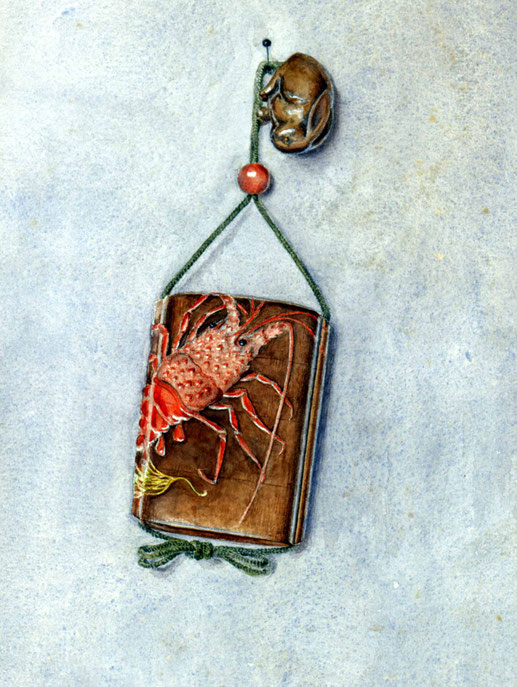
Collingwood's paintiing of an inro and netsuke in his collection
Collingwood had a fine collection of Japanese art and left some 1000 pieces to the British Museum. Oriental antiquities specialists Lawrence Smith and Victor Harris paid several visits to The Grange in connection with the bequest: the former wrote an appreciation of Collingwood in the British Library Journal in 1981.
“When I first met Collingwood Ingram he was 93. He met me at Staplehurst Station, in Kent, in his car, set me in the passenger seat and asked me to keep an eye open for lorries. His eyesight was not what it had been, though he still looked like a very old, brilliantly blue-eyed hawk, and he navigated by driving straight down the central white line. I shouted occasionally when I saw a large vehicle coming. But since he was almost deaf by then it didn’t do much good. He survived as he always had done. It was a genuine surprise to hear of his death in May at the age of 100. I thought he would break all British records and go on for at least another decade. ……”
Lawrence Smith went on to describe the rigorous conditions of the attic in which the antiquities were kept,
“…… What brought us there was not those sides of his life that made him a celebrated figure as a horticulturalist, countryman, ornithologist and belle lettrist. These were all mentioned in the obituaries in the national newspapers. It was his collection of Japanese decorative arts .…... He kept them in beautifully made walnut cabinets with glass lidded drawers which were almost airtight. Interestingly enough for conservationists the lacquered pieces survived there the undeniable rigours of the Captain’s attic, where the difference in temperature between winter and summer seemed to be some 60 degrees Fahrenheit …….
…… He loved good craftsmanship, but he loved the natural world even more. He collected therefore many wonderful inro (lacquered seal cases) and tsuba (sword guards) elaborately and naturalistically decorated with birds , plants, animals, fish and insects. Most of all he loved lobsters – an interest reflected in weekly expeditions from his house in Benenden to a Hastings lobster-fisherman with whom he always bargained with his usual cheerful asperity. But the Captain, however outspoken, commanded affection. The lobster man travelled up especially on the Captain’s hundredth birthday to make a particularly juicy offering for his lunch. The finest tsuba collection, not made for use, is encrusted with a quite remarkable metal sculpture of Captain Ingram’s favourite crustacean.”


