 COLLINGWOOD INGRAM
ornithologist
and plantsman
COLLINGWOOD INGRAM
ornithologist
and plantsman
Basle: Great Black Woodpecker
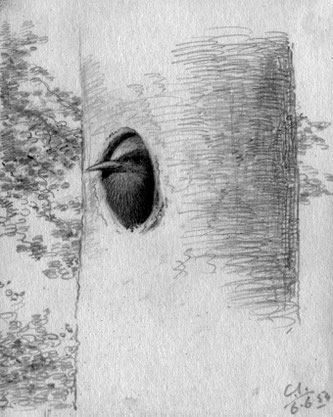
At the International Congress in Basle, Collingwood gave a paper on the moult with the title, as published in the conference proceedings. of The order in which the remiges and rectrices are moulted in certain birds. His daughter Certhia remembered dining on blackbird, or was it starling, pie while research for the paper was in progress. But again, it was the post-conference excursion that featured in his journal.
Basle, Switzerland, 6 June 1954
The star turn was undoubtedly the Great Black Woodpecker. I had only once previously encountered this magnificent bird and that was in the Pyrenees some forty years ago when I remember being greatly impressed by its loud and rather curious drumming. This Woodpecker’s nest was in a very lofty beech tree, one of many huge specimens. Sitting at the mouth of the elliptic-shaped hole was one of the nearly fledged youngsters which were clamouring at frequent intervals for food. Neither its red crown nor its dusky body plumage were as brightly coloured as the adult, but the general pattern appeared much the same.
We had to wait a long time before we got a really good view of either parent, for both were extremely shy and having once detected us crouching in a thicket, would first alight on the farther side of the trunk and then, having taken another look at us, promptly make off. From a nearby tree they would then utter a loud mooing kee-ow, evidently a cry of distress or, more likely, a danger signal. These warnings however went unheeded by their hungry progeny who continued their yaffle-like cacklings for food regardless of our presence. It was well over an hour before the male mustered enough courage to visit the nest and this it did only after we had withdrawn to a greater distance. The fledgling was fed by regurgitation, a process which lasted about 30 seconds. The meal over, the old bird flew to a neighbouring tree and did a short drum, which I understand was its usual practice after feeding its young.


