 COLLINGWOOD INGRAM
ornithologist
and plantsman
COLLINGWOOD INGRAM
ornithologist
and plantsman
Swedish Lapland
The publication of Ornamental Cherries marked the culmination of 25 cherry years and Collingwood felt able to return to ornithology. He was of course years out of date as regards the development of the science, but he wanted to pick up the threads and attended three successive International Ornithological Congresses. The first was in Uppsala, Sweden. After the lecture programme, during which he sketched some of the ornithologists, he joined the Congress excursion to Swedish Lapland.
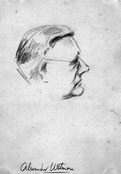
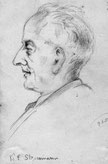
Eminent ornithologists at the Congress, Alexander Wetmore (1886-1978) left, American,
and
Ewin Stresemann (1889-1972). of Germany. right
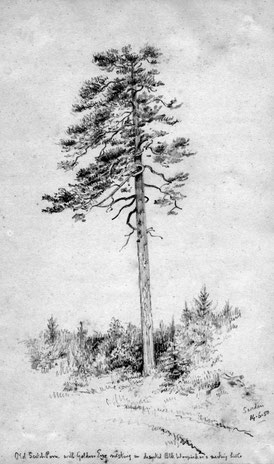
Swedish Lapland, 16 June 1950
……About 40ft up the trunk of this tree was a nest hole bored by a Black Woodpecker and in this, I was told, a pair of Goldeneyes were breeding. How these ducks managed to fly into the hole is a mystery. It is also amazing that the young are able to survive to drop on to moss-covered stones without being killed and the subsequent mile journey through the forest to the nearest lake must also be a formidable undertaking for them.

Swedish Lapland, 23 June 1950, excursion to see a Lapland Bunting …… It proved a long six mile drag up to the stony mountainside where the Buntings were breeding, but we were well rewarded for our pains. The male was in splendid plumage and looked very handsome with his jet-black apron and cap, and his brightly coloured chestnut nape contrasting sharply with white cheek patches and breast. He very obligingly sat for a long time on a small boulder, reiterating what perhaps may have been a distress call, since it would hardly be termed ‘a short but lively outpouring of notes’ which is how the Handbook describes its song. The call was a melodious ter-loo, ter-loo, and was occasionally followed by a more bunting-like chirp


