 COLLINGWOOD INGRAM
ornithologist
and plantsman
COLLINGWOOD INGRAM
ornithologist
and plantsman
Aldabra, Bird Island and birds's eggs
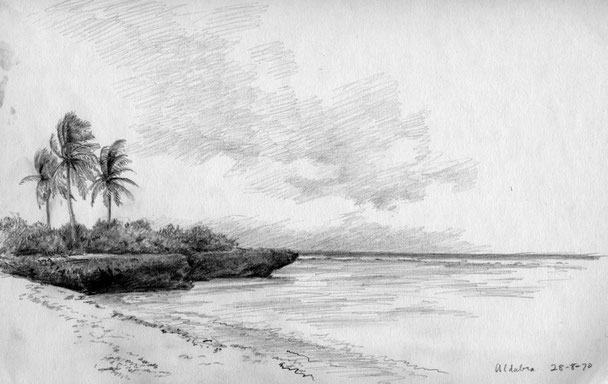
Aldabra
In 1970 Collingwood went on a cruise in the Indian Ocean, taking in Aldabra nd Sea Cow Island, also known as Bird Island.
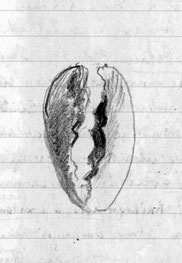
Sooty tern egg after hatching.
Sea Cow Island, Indian Ocean, 21 August 1970
Sooty Terns were nesting – some have estimated their numbers as over a million. They all had young, possibly two or three weeks old; at any rate they were old enough to run about. Many of them had their beaks open, panting from the very considerable tropical heat. They were clothed in a rather dark, brownish grey down through which (on the mantle) spotted contour feathers were sprouting. By sitting still amongst these baby terns, I was soon surrounded by their white-bellied screaming parents, who displayed some annoyance but very little fear at my presence among them. Lying about in fairly large quantities were the discarded shells of their hatched eggs. I was interested to note that these showed no tendency to having been divided into two distinct parts around the broadest circumference, as is customary with the empty shells of most British birds (i.e. Woodpigeon, Pheasant and others). They had been fractured in a most haphazard manner by the emerging chick for no two shells were broken in the same way.
These observations on broken eggs led him to some experiments when he returned home. He asked the question – why do the eggs of British birds fracture around the circumference? He looked at the limited literature he could find. A booklet on poultry eggs told him that, on the point of hatching, the developed embryo rotates in the egg, using its feet as leverage, to chip though the shell in a line around the circumference. Collingwood was scathing – this ‘was a physical impossibility, and therefore nonsense – its tightly cramped position in the egg would inhibit any such movement.
Collingwood had sketches to prove his point, a Guacharo embryo in 1957 (p. ..) and a chaffinch in 1920 (p…), He had also observed hatching in the Greenfinch seventy years earlier .
28 May1900, Westgate
I watched two baby greenfinches leave the eggshell today. In both cases the egg was broken in a more or less zone around the broadest part, the tine occupants at every breath expanding themselves as much as possible, using, I think, their limbs at the same time. The egg, as far as I have seen, is always cracked in a small hole in this portion of the shell and is afterwards divided into two pieces, separating in a circle running through the hole first made by the egg-tooth. In a plover’s nest this year I found the eggs all broken at this place and at the same time (about mid-day).
He had an alternative theory for the fracture around the circumference, pu forward in booklet Random Thoughts on Bird LifBird Life, privately printed around 1975.
I have an idea that the cause in the uniformity of the break in our birds is due to the membrane lining of the lower portion of the egg remaining moist and therefore more elastic than the upper part containing the air sac. Where it becomes drier and therefore more brittle. This causes the shell to fracture at the junction of the two parts to form a girdle round the larger end of the egg. He further suggested that the tropical eat of Sea Cow Island desiccates the whole egg, so there is no fracture junction.
In this case it seems that Collingwood was wrong, It is now widely accepted that emergence from the egg is by first “pipping”, breaking the shell at one point and then by “zipping,” cutting the shell around the circumference by rotating, Rotating by the chick becomes possible once it has broken into the air cell at the broad end of the egg and given itself a little room to manoeuver, and still more room once it has pipped.
Anyone can now see the process in online videos. It is less neat than “zipping” might suggest and in some cases at least, a small hole is made and then a wider “horizontal” crack follows, apparently due to the struggles of the chick, rather than by rotating and cutting. Collingwood suggested that there might be a line of weakness between the relatively dry, hence more brittle, area of the shell around the air cell and the moister area around the rest of the egg.
[editorial comment, if permitted! - an egg is weakest round its greatest circumference, hence a line of weakness is expected here]
Collingwood at 90, albeit largely wrong, was still thinking - and making us think.
..


