 COLLINGWOOD INGRAM
ornithologist
and plantsman
COLLINGWOOD INGRAM
ornithologist
and plantsman
Blythe's Warbler in Finland
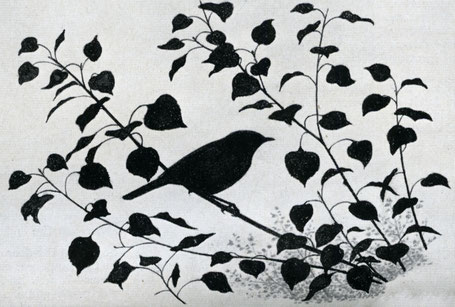
Otaniemi, Finland, International Ornithological Congress, 10 June
1958[1]
Apparently, during its sojourn in Finland, this individual could invariably be found between the hours of midnight and one a.m. and always in identically the same place – a roadside belt of trees bordering some marshy land on the outskirts of Helsinki. ……
…… The almost continuous outpouring of sound, patently composed of a series of borrowed phrases, was strung together is such a way as to form a most delightful harmonious whole. The little musician’s repertoire was indeed astonishing. It seemed to me that the mimicked noted and phrases were is some way all beautified by this repeat performance – that the tones and inflections were purer and sweeter than the originals. Among the birds imitated, I recognised, or thought I recognised, the Great Tit, Redstart, Starling, Fieldfare, Goldfinch, Robin (ticking), and Garden Warbler, both song and scolding chatter, and that of the Sedge Warbler. Blyth’s Warbler also introduced into its melody a very lovely note which I think must be of its own. The copied phrases changed from one to another so rapidly and so drastically that one could almost swear that these were two separate performers. The song of this species has been likened to that of a Marsh Warbler, but actually it is very distinct. For one thing it has far fewer harsh passages and is more therefore more pleasing to the ear and moreover it possesses many beautiful, enchanting flute-like notes.
I doubt if any individual bird has had a more cosmopolitan human audience than this one. There must have been representatives of at least a score of countries standing in silent admiration listening to its ceaseless flow of melody.
At the Helsinki Congress, Japanese ornithologists were no doubt amazed to find that the Ingram present was the same Ingram who had
[1] Sketch of Blythe’s Warbler from an article by Collingwood in Country Life, June 1959.


